
The Global Sugar Supply Chain — From Farms to Global Markets
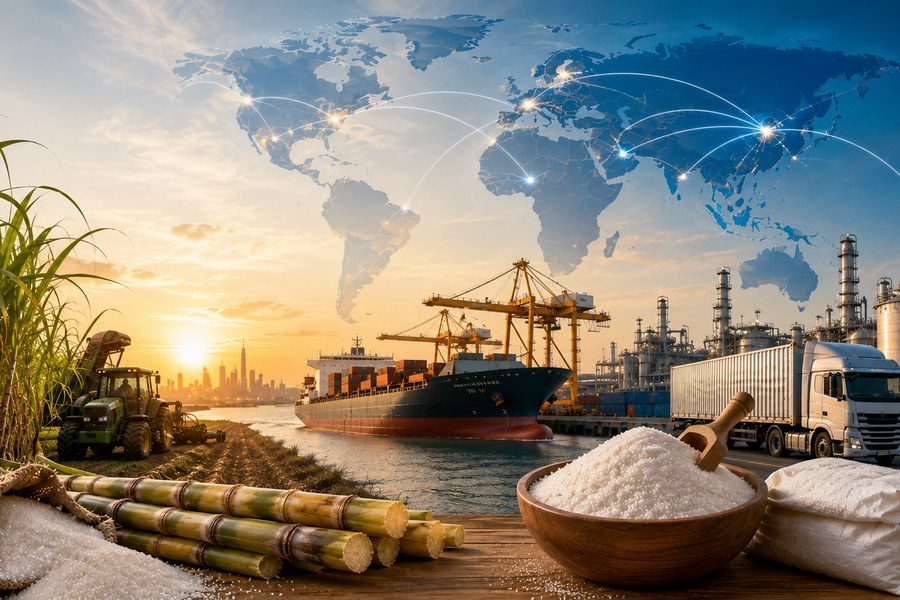
Sugar is among the world's most heavily traded agricultural commodities, yet few people consider the journey it takes before reaching a supermarket shelf or a food manufacturer's production line — a coordinated network spanning farmers, mills, refineries, ports, shipping companies, banks, inspection agencies and distributors.
In an era defined by geopolitical uncertainty, climate volatility and increasingly fragile logistics networks, understanding how sugar moves across the world has become a strategic necessity for producers, traders, importers and investors alike.
Where the Journey Begins
The global sugar industry starts in the fields. More than 85% of the world's sugar is produced from sugarcane, cultivated across tropical and subtropical regions, with the remainder from sugar beet grown primarily in Europe and North America.
Brazil remains the undisputed leader of the industry, accounting for the largest share of global production and exports. India follows as the world's second-largest producer, while Thailand has established itself as one of Asia's most influential exporters. Australia, Guatemala and Mexico also play vital roles supplying regional markets. Because harvesting seasons vary across producing countries, international buyers are able to diversify sourcing throughout the year, reducing seasonal supply risks.
The Supply Chain That Connects Continents
Once harvested and processed into raw sugar, the commodity begins its second journey. Millions of tonnes are transported from inland production regions to export terminals before entering an intricate network of international shipping routes.
Few locations illustrate the importance of connectivity better than Dubai. Positioned at the crossroads of Europe, Asia and Africa, the UAE has evolved into one of the world's most significant logistics and re-export hubs. Its modern ports, efficient customs procedures and integrated transport infrastructure enable raw sugar arriving from South America, Asia and Australia to be refined, stored and redistributed efficiently to rapidly growing markets throughout the Middle East, Africa, Central Asia and South Asia.
Adding Value Beyond Production
Global sugar trade does not end with harvesting — for much of the industry, it is only the beginning. Most internationally traded sugar is initially shipped as raw sugar before undergoing refining, a sophisticated industrial process that removes impurities and transforms the product into high-quality white sugar suitable for food manufacturers, beverage companies and retail markets.
Regional refining centres, particularly in the UAE, have become increasingly important by linking global production with regional consumption while ensuring international quality standards are consistently maintained.
Demand Continues to Shift
The geography of sugar consumption is changing. While mature economies remain important consumers, much of the future growth in demand is expected to come from emerging markets. Countries across the Gulf, the Levant, Africa, Central Asia and South Asia continue to rely heavily on imported sugar as urbanisation accelerates, food manufacturing expands and rising incomes reshape consumer behaviour.
Why Sugar Prices Are So Sensitive
Few agricultural commodities respond to as many external variables as sugar. Weather conditions in Brazil, export policies in India, freight rates in the Red Sea, oil prices, exchange rates and geopolitical developments can all influence global prices within a remarkably short period. Even a localized disruption can ripple through international markets because the sugar trade depends on a tightly interconnected global network.
Trade Finance: The Invisible Foundation
Behind every successful sugar transaction lies an equally important financial structure. International commodity trading depends on instruments such as Letters of Credit, trade finance facilities, marine cargo insurance, independent inspections, certified warehousing and hedging strategies designed to manage commercial and operational risk. Without them, global trade would slow considerably.
Reading the Market Through Global Benchmarks
International sugar prices are primarily referenced against two benchmark futures markets: ICE New York No.11 for raw sugar, and ICE London No.5 for refined white sugar. The difference between these two benchmarks — the White Premium — offers valuable insight into refining economics, market balance and refinery profitability.
Building More Resilient Supply Chains
The global sugar industry is no longer defined solely by production volumes. Competitive advantage increasingly depends on visibility, diversification and resilience. Companies that maintain multiple sourcing origins, develop trusted logistics partnerships and integrate robust trade finance structures are significantly better equipped to navigate market volatility while maintaining uninterrupted supply.
In today's trading environment, success belongs not simply to those who produce sugar, but to those who understand how the world's sugar moves.
Success belongs not simply to those who produce sugar, but to those who understand how the world's sugar moves.
- Over 85% of the world's sugar comes from sugarcane, led by Brazil, India and Thailand, with harvest-season diversity helping buyers manage supply risk year-round.
- Dubai has become one of the world's largest sugar refining and re-export hubs, connecting South American, Asian and Australian production to Middle East, African, Central Asian and South Asian markets.
- Sugar prices respond to an unusually wide range of variables — Brazilian weather, Indian export policy, Red Sea freight rates, oil prices and FX can all move prices quickly.
- Trade finance instruments (LCs, marine cargo insurance, hedging) are the invisible foundation that makes large-scale international sugar transactions possible.

Atefeh Hosseini
Business Development Manager, Qasr Al Anqaa Group of Companies
Writing on commodity supply chains, market access and trade logistics at QAA.