
The Global Rice Supply Chain
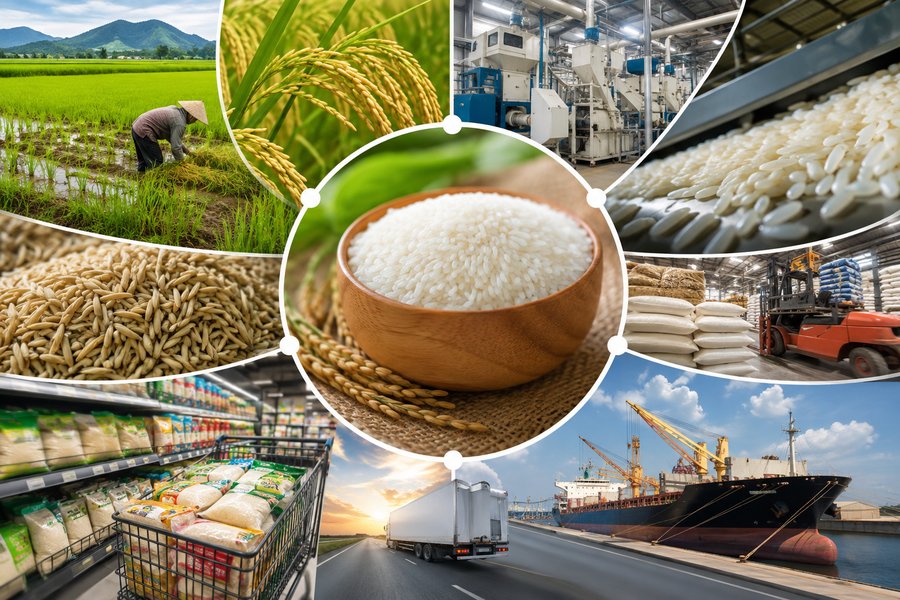
Rice may look like one of the simplest commodities on a supermarket shelf. Its supply chain is anything but simple — from seed selection and harvesting to milling, grading, export documentation, shipping, finance and final distribution, every tonne passes through decisions that change its quality, cost and commercial value.
Rice does not simply move through the supply chain. Quality moves through it. Capital moves through it. Documents move through it. Risk moves through it.
Walk into a supermarket in Dubai and pick up a bag of rice. It may be Indian or Pakistani Basmati, Thai Jasmine, parboiled rice or ordinary long-grain white rice. What the consumer sees is simple: a bag, a brand, an origin and a price.
Behind that bag sits an international supply chain involving farmers, collectors, millers, laboratories, traders, banks, insurers, freight forwarders, shipping lines, ports, customs authorities, importers, warehouses, distributors and retailers.
Understanding where each of those elements changes is essential to understanding the real economics of the global rice trade.
Production, Harvesting and Drying: Where the Supply Chain Actually Begins
The rice supply chain begins long before a buyer requests a quotation — it begins with the crop itself. Variety selection, seed quality, soil conditions, irrigation, fertiliser, pest management, labour availability and weather all influence what will eventually become a commercially tradable grain.
Rice is not a uniform commodity. Aromatic varieties such as Basmati and Jasmine occupy very different commercial positions from ordinary long-grain white rice. Grain length, aroma, cooking characteristics, yield and processing performance eventually influence both market positioning and price. Poor crop management cannot always be corrected by sophisticated milling — the mill can improve and standardise a good agricultural product, but it cannot completely reverse damage already created in the field.
Timing matters enormously at harvest. Grain harvested too early may contain immature kernels; harvesting too late can increase field losses and create other quality problems. At harvest, paddy may contain roughly 20–25% moisture — the grain is alive, biologically active and vulnerable, and how quickly it is handled, threshed and moved towards drying can influence its later storage stability and milling performance.
Freshly harvested paddy cannot simply be placed in a warehouse and forgotten. Drying is one of the most important post-harvest operations because excessive moisture can contribute to mould, discoloration, deterioration and pest activity during storage. For rice intended for milling, moisture around 13–14% is generally an important target — but over-drying can make kernels brittle and increase breakage during milling, while inadequate or uneven drying can create storage problems. The commercial objective is the same whatever the technology: stabilise the paddy without damaging the grain that will later have to survive milling.
Storage and Milling: Where Time and Value Are Made or Lost
Once dried, paddy may move into storage before milling. This stage is sometimes treated as passive — it is not. Moisture, temperature, insects, rodents, contamination and warehouse hygiene can all affect the grain, and longer storage periods generally require tighter moisture control. From a commercial perspective, storage introduces another factor: the cost of capital. Every tonne sitting in a warehouse represents money tied up in inventory, so storage has two simultaneous costs — the physical cost of maintaining the product and the financial cost of holding it.
Milling is where the appearance and commercial identity of rice change dramatically. Paddy arrives with its protective husk, and modern commercial milling may involve several distinct operations: pre-cleaning → dehusking → paddy separation → de-stoning → whitening → polishing → sifting → length grading → blending → weighing and bagging. Modern mills can typically produce roughly 65–70% milled rice from incoming paddy, depending on the variety, equipment, moisture and quality of the grain — a recovery rate that is commercially important, since a mill producing more whole kernels and fewer brokens creates more value from the same volume of agricultural input.
Grading, Quality Control and Packaging: Turning Paddy Into a Commercial Specification
There is no single product called simply "rice" in international trade. A contract may distinguish between Basmati, Jasmine or other varieties; long-, medium- or short-grain rice; white, brown or parboiled rice; 5%, 10%, 15%, 25% or other broken percentages; different grain lengths, moisture limits, crop years, milling degrees, purity requirements and foreign-matter tolerances. A 5% broken white rice cargo is commercially different from 25% broken rice, and aromatic premium rice serves a different buyer and consumer segment from commodity-grade rice. The specification therefore determines not only quality — it determines the market into which the cargo can be sold.
Once a specification exists, somebody has to verify compliance. Quality checks may examine moisture, broken percentage, foreign matter, damaged grains, grain dimensions and milling quality, and independent inspection may also be required. But inspection does not eliminate the need for a precise contract — an inspection company can test against defined parameters, but it cannot compensate for a poorly written specification.
Packaging protects the grain from moisture and contamination, makes handling and transport possible, and carries regulatory and product information. In retail markets it also becomes part of the commercial positioning of the product itself: a premium Basmati brand sold through a Gulf supermarket has very different packaging requirements from commodity rice supplied to an institutional buyer.
Inland Logistics and Export Documentation: The Parallel Supply Chain
Before the vessel appears, rice has to move from production areas or mills to consolidation points, warehouses, container yards or export terminals — by truck, rail or a combination, depending on origin. Distance to port, road conditions, fuel costs, container availability, loading capacity and inland congestion all matter. A competitive ex-mill price can lose its advantage if inland logistics are expensive or unreliable — the cheapest rice at the mill is not necessarily the cheapest rice at destination.
While the physical rice is moving towards the vessel, a parallel documentary chain moves alongside it: the commercial invoice, packing list, weight documents, certificate of origin, phytosanitary certificate, inspection certificate, bill of lading, insurance documentation and customs and export paperwork. These documents establish ownership and shipment details, demonstrate origin, quantity, plant-health compliance and conformity with contractual requirements. Documentation is not administrative decoration — a cargo can be physically perfect and commercially problematic because one document is missing, inconsistent or issued incorrectly.
Trade Finance: When the Grain Meets the Bank
Rice requires capital at multiple points in its journey. Farmers need production finance. Collectors and mills need working capital. Exporters may have to purchase, process and hold inventory before receiving payment, while importers may finance goods still at sea or sitting in a warehouse. International transactions can use advance payment, documentary collection, open-account terms or letters of credit depending on the relationship and risk profile.
Under a documentary letter of credit, an important principle applies: banks deal primarily with documents, not the physical rice. A bank does not open the container and judge whether the Basmati smells right — it examines whether the presented documents comply with the terms of the credit. This means documentary precision directly affects payment risk.
Port, Ocean Freight and Incoterms: Geography Becomes Economics
At the export port, the cargo may undergo customs procedures, terminal handling, weighing, inspection, container movements or vessel loading. Timing becomes particularly important — missing a vessel schedule can mean additional storage, handling and financing costs, and port congestion or documentation delays can prevent cargo from moving even when the physical goods are ready.
Once loaded, freight can materially change the competitiveness of one origin against another. Distance, vessel availability, container rates, fuel costs, port congestion and shipping schedules all influence the landed cost. This is particularly relevant to Gulf markets: India and Pakistan benefit from geographical proximity to the UAE compared with more distant origins, and in 2024 India supplied approximately 598,000 tonnes of rice to the UAE, while Pakistan supplied roughly 205,000 tonnes. But a shorter voyage does not automatically mean a safer transaction — freight is only one component of risk.
International rice quotations are often expressed using terms such as FOB, CFR or CIF, and these terms allocate specific responsibilities, costs and risks between seller and buyer. A FOB quotation and a CIF quotation cannot be compared simply by looking at the headline numbers — the buyer needs to understand what is included, where risk transfers and which party controls the relevant part of the transport chain. A containerised shipment of branded Basmati and a large bulk commodity shipment are operationally different transactions, and the contract should reflect that reality.
Import Clearance, Warehousing and Distribution: Turning an Import Into Available Supply
Arrival at the destination port does not mean the rice is immediately available for sale. Documents may be checked, customs procedures completed, food-safety and phytosanitary requirements applied, and duties, taxes, port charges and other costs settled. A documentation discrepancy may delay clearance, a regulatory problem may require further inspection, and a delay may generate storage or demurrage charges — the rice can be physically present in the destination country while remaining commercially unavailable.
After clearance, rice enters the domestic distribution system — moving to an importer's warehouse, a distributor, a wholesaler, a food-service supplier, a processing company or directly into a retail network. Different grades, brands, crop years and package sizes may need segregation, and warehousing conditions continue to matter because rice remains sensitive to moisture, pests, contamination and poor handling. A successful import is not simply a cargo that cleared customs — it is a cargo that can be converted into sales.
Retail and Consumption: The Final Stage Hides Everything Before It
Eventually, the rice reaches a supermarket, restaurant, wholesaler, manufacturer or household. A 5 kg bag may look simple. Its price is not — it incorporates agricultural production, harvesting, drying, storage, milling losses, grading, packaging, inland transport, inspection, documentation, financing, port handling, ocean freight, insurance, customs, destination warehousing, distribution and retail margin. And every unnecessary day somewhere in that chain has a cost.
The Global Trade Map: Production Is Not the Same as Export Power
Global rice production is enormous, but international trade represents only a relatively small part of it. USDA data for 2025/26 puts global milled-rice production at roughly 540 million tonnes, while exports are around 63 million tonnes — only approximately 12% of production therefore enters international trade. India alone is projected to represent roughly 40% of global rice exports.
This creates structural concentration. China may be one of the world's largest rice producers, but much of its production is consumed domestically — the same principle applies to other large Asian producers. Export power is concentrated much more heavily around India, Vietnam, Thailand and Pakistan, which is why a policy change in one exporting country can affect buyers thousands of kilometres away.
Policy Can Change the Price Without Changing the Grain
International rice prices are influenced by much more than crop quality. Weather can change supply. Fertiliser and energy can change production costs. Currencies can change exporter competitiveness. Freight can change landed economics. Large government tenders can alter demand. And government policy can suddenly change how much rice is available to the world market.
India's restrictions on non-Basmati white rice exports in 2023 demonstrated this clearly. Buyers moved towards alternative suppliers such as Thailand and Vietnam, contributing to pressure on international quotations. As restrictions were subsequently relaxed, more supply returned to the market. The grain itself did not need to change for the economics of the trade to change.
Where Does the Rice Supply Chain Actually Break?
The most interesting risk in rice trade is that the grain can remain perfectly good while the transaction fails around it. The cargo may not meet the contracted specification. It may be loaded late. The vessel may be delayed. Freight may rise. A phytosanitary issue may hold up clearance. Documents may contain discrepancies. Payment under a letter of credit may be delayed. The buyer may receive the cargo after an important sales window. Or the final landed cost may simply become too high.
There are therefore two fundamentally different categories of failure. Physical failure occurs when the product itself loses quality. Commercial failure occurs when the product remains acceptable but the economics, timing, documents, finance or logistics of the transaction fail. A sophisticated buyer has to manage both.
Not the cheapest tonne at origin — the tonne that arrives at the required quality, at the required time, with compliant documents and at a cost that still allows the buyer to sell profitably.
The Real Cost of Rice
This is ultimately why asking only for the lowest quotation is the wrong way to evaluate a rice transaction. Suppose Supplier A offers a lower FOB price and Supplier B is slightly more expensive — on paper, Supplier A appears to be the obvious choice. But what if Supplier B is closer to the destination? What if its mill produces more consistent quality? What if its documentation is stronger? What if its vessel schedule saves ten financing days? The difference between the two suppliers cannot be understood from FOB price alone. The real commercial equation is closer to:
That final number is what matters — not the cheapest tonne at origin, but the tonne that arrives at the required quality, at the required time, with compliant documents and at a cost that still allows the buyer to sell profitably.
One Grain, Four Supply Chains
The global rice trade is easiest to understand when it is viewed not as one supply chain, but as four chains operating simultaneously:
The physical chain: Farm → Harvest → Drying → Storage → Milling → Grading → Packaging → Inland Transport → Port → Vessel → Import → Warehouse → Distribution → Retail
The quality chain: Variety → Moisture → Milling Recovery → Broken Percentage → Purity → Inspection → Condition at Destination
The documentary chain: Specification → Contract → Invoice → Packing & Weight Documents → Origin → Phytosanitary → Inspection → Bill of Lading → Customs
The financial chain: Production Capital → Inventory Finance → Trade Finance → Payment → Freight & Insurance → Import Finance → Working Capital → Final Sale
A weakness in any one of them can affect the entire transaction. That is why securing rice supply is not simply about finding the lowest price — it is about understanding where the rice was grown, how it was harvested and milled, how its quality was defined, who inspected it, how it was financed, when it will ship, what documents will move with it, what it will cost to land and where risk changes hands along the journey.
A bag of rice may look like a simple product. The business behind it is a system. And in international commodity trade, the companies that understand that system are usually better positioned to distinguish a cheap quotation from a genuinely good trade.
QAA structures rice supply against exactly this kind of specification — see our own rice sourcing programme, and track daily rice pricing and trade signals on QAA Intelligence's live rice market analysis.
- Rice is not one product — variety, grain length, broken percentage, moisture and milling degree all change the market a cargo can be sold into
- Only around 12% of global rice production enters international trade, and India alone represents close to 40% of global exports — a concentration that lets policy changes reprice the market quickly
- Documents and trade finance move alongside the physical cargo — a bank examines whether documents comply with the credit, not whether the rice itself is good
- The lowest FOB price is rarely the best trade once inland logistics, inspection, freight, insurance, finance cost, customs, warehousing, delay and risk are added to the real landed cost

Amit Tata
Commodities & Markets Contributor, CARAVAN
Amit Tata writes on commodity supply chains, trade finance and market access for CARAVAN.